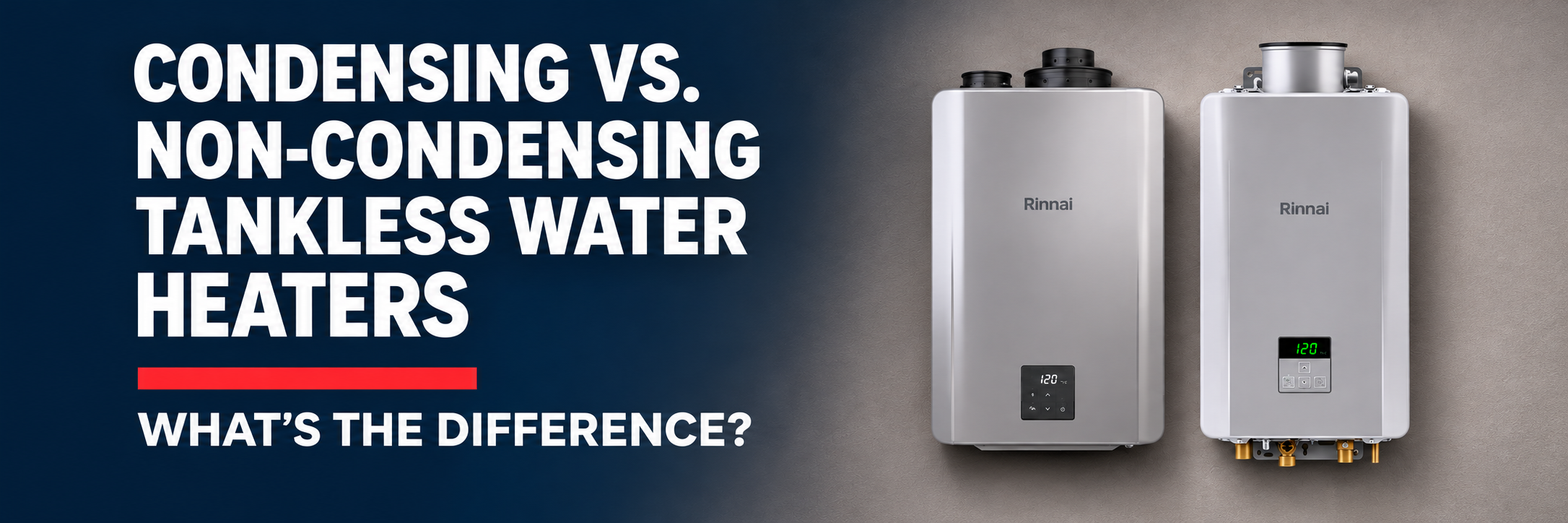
If you’re shopping for a gas tankless water heater, you’ll probably see two terms over and over: condensing and non-condensing. Both heat water as you need it. The main difference is how much heat they capture from the gas they burn.
That difference affects efficiency, venting, drainage, and installation cost. For a homeowner in Charleston or Summerville, the right choice depends on the house as much as the heater.
How each type heats your water
Inside a gas tankless water heater, a burner heats a heat exchanger. That’s the part that transfers heat into the water flowing through the unit. The water and combustion gases stay separated.
A non-condensing model typically uses one heat exchanger. After transferring heat to the water, it sends the remaining hot exhaust outside through its approved vent system.
A condensing model captures more of that leftover heat. Many designs use a second heat exchanger to preheat incoming cold water with heat from the exhaust. As the exhaust cools, some of its water vapor turns into liquid, releasing additional heat that can be recovered.
That liquid is called condensate. It’s a normal part of how a condensing heater works, and it needs a properly installed drainage system.
How much more efficient is condensing?
Condensing gas tankless heaters generally have higher efficiency ratings than non-condensing models. Look for the Uniform Energy Factor, or UEF, when comparing specific units.
For example, Rinnai lists its condensing RX199iN at 0.98 UEF and its non-condensing RE199iN at 0.82 UEF. Those are examples from two models, not ratings that apply to every heater in either category.
UEF is based on standardized testing. Compare models in the same usage category, sometimes called a draw-pattern bin, and use the EnergyGuide information to help evaluate operating costs.
A higher UEF doesn’t tell you exactly how much your gas bill will drop. Your hot water use, gas rates, settings, and installation all matter. A household using very little hot water may see a smaller dollar difference than one using much more.
Why the venting matters
Recovering more heat leaves a condensing heater with cooler exhaust. Depending on the model and applicable requirements, that may allow approved PVC, CPVC, polypropylene, or stainless-steel venting.
Non-condensing units have hotter exhaust and need a vent system rated for it. Some approved concentric systems have a metal exhaust passage inside a plastic outer pipe. You can’t judge compatibility just by looking at the outside.
The important question is which vent system the exact heater permits. Material, diameter, length, fittings, clearances, and termination location all need to match its installation requirements.
An existing vent isn’t automatically reusable, even when you’re replacing one tankless heater with another. Have it checked before assuming it will reduce the installation cost.
What happens to the condensate?
The condensate from a condensing heater is acidic. It needs an approved drain route using suitable materials, rather than dripping wherever the heater happens to be mounted.
A condensate neutralizer treats that acidity before discharge. Whether one is required depends on the equipment instructions, the drainage arrangement, and local requirements. Its treatment media also needs attention over time.
If gravity drainage isn’t practical, an appropriate condensate pump may be part of the installation.
Non-condensing heaters don’t intentionally recover heat by condensing exhaust in a secondary stage. Still, some vent arrangements need condensate collection or drainage. “Non-condensing” should not be taken to mean that drainage never needs consideration.
Which costs less to install?
Non-condensing equipment often has a lower purchase price. Condensing equipment typically costs more upfront, but approved venting options may help offset part of that difference on some jobs.
The total installed price is what matters. A comparison should account for the heater, vent route, gas supply, electrical connection, water piping, drainage, and any required accessories.
An existing non-condensing installation may be a practical candidate for a similar replacement if its supporting systems are compatible and in good condition. A condensing model can also be a good retrofit when the venting and drainage can be arranged sensibly.
There isn’t a reliable one-price answer for every Charleston-area home. A quote based on the actual installation is more useful than a national equipment-price range.
Both types need proper sizing and maintenance
Neither design gives you unlimited hot water flow. The heater must be sized for the fixtures you expect to use at the same time and how much it needs to raise the incoming water temperature.
Ask about output at your required temperature rise, not just the biggest gallons-per-minute number on the box.
The gas supply needs attention too. A tankless heater may require changes to the gas piping or supply capacity. The existing pipe’s diameter alone doesn’t answer that question; length, available pressure, and other gas appliances matter.
Both types also need maintenance. Mineral buildup can affect the heat exchanger, and inlet filters need checking. Follow the model’s service instructions and a schedule that accounts for your water quality and usage. Condensing systems also need their condensate components checked, including a neutralizer when fitted.
Which one makes sense for your home?
A condensing model is worth considering when you want higher gas efficiency and the installation can accommodate its venting and drainage needs.
A non-condensing model may make sense when upfront cost is a priority or when a compatible replacement keeps an existing installation straightforward.
Before choosing, have a professional compare the complete installations rather than just the two appliances. That gives you a clearer picture of what you’ll pay now, what you’ll maintain, and how the system will meet your household’s hot water demand.
Drip Doctor Plumbing helps homeowners in Charleston, Summerville, and surrounding communities evaluate their water heater options. Contact us to discuss your existing setup and which tankless system fits your home.