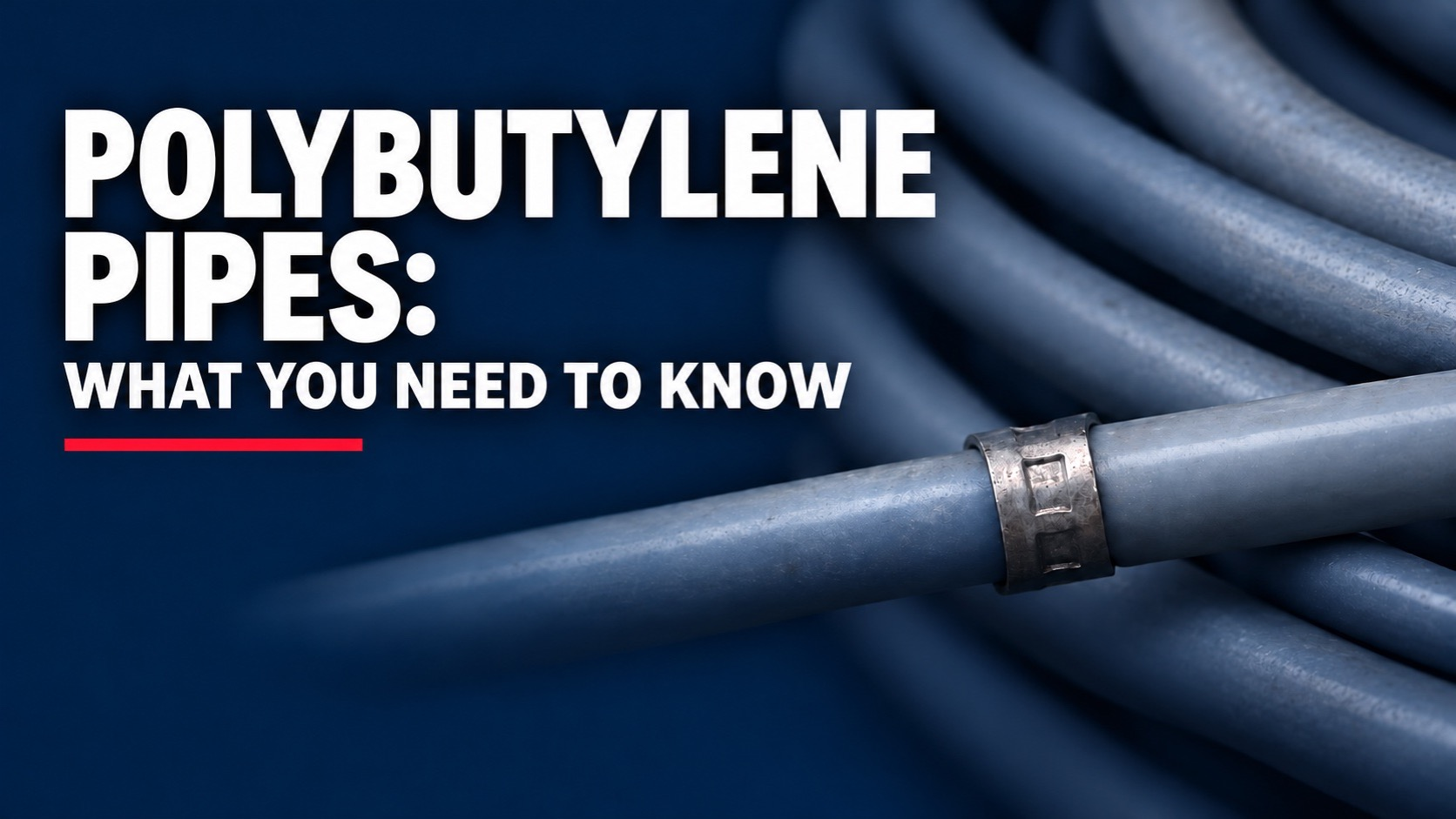
If you’ve been told your home has polybutylene pipes, you probably have two questions: What’s wrong with them, and do they need to be replaced?
Polybutylene has a documented history of pipe and fitting failures. The concern is that deterioration can develop inside the plumbing before a leak becomes visible. That makes it worth understanding what is in your home and planning your next step, even if the pipes haven’t given you trouble yet.
Here’s what homeowners in Charleston, Summerville, West Ashley and surrounding communities should know.
Polybutylene, also called Poly-B or PB, is a plastic used in older water-supply piping. It carries water to fixtures such as sinks, showers, and toilets. This is the pressurized supply side of your plumbing, not the drain or sewer piping that carries wastewater away.
It was widely used in U.S. homes from the late 1970s through the mid-1990s. A HUD-hosted plumbing design guide gives the approximate period as 1978–1995.
A home’s age is a starting point, not a diagnosis. Plumbing may have been replaced, added, or repaired since construction. A house can also contain more than one type of water pipe.
The problem can start at the inside surface, where the pipe contacts water.
Research has documented a gradual process: protective antioxidants in the plastic become depleted, the inner material deteriorates and becomes brittle, and cracks develop. Under stress, those cracks can grow through the pipe wall and cause a leak or rupture. Chlorinated water can accelerate this process.
A published study of PB pipe in chlorinated water found antioxidant depletion and cracks beginning at the inner wall. Those were accelerated laboratory tests, so they explain a failure mechanism rather than predict how many years a particular home’s pipes have left.
Temperature, pressure, and mechanical stress also matter. A NIST workshop report describes PB failures involving both chemical and mechanical damage, including cracking that began inside the pipe. One example showed substantial internal cracking before the pipe had leaked.
The practical concern is straightforward: a dry, normal-looking exterior does not tell you everything about the condition inside. It also does not mean every PB system is about to burst.
No. Some plastic fittings had their own degradation problems, but failures were also documented in the PB tubing itself. Replacing a plastic fitting with a metal fitting does not replace the pipe connected to it.
The Plastics Pipe Institute’s technical guidance distinguishes between the historic fitting problems and the tubing’s resistance to hot chlorinated water. It also explains that PB and PEX are different materials. They should not be treated as interchangeable simply because both are plastic.
Connections and workmanship still need attention. A leak at a joint does not, by itself, prove that the pipe chemically degraded. The failed component and the way it was installed need to be evaluated.
You may hear polybutylene called “Quest.” The plumbing-system brand was spelled Qest.
Several companies played different roles. U.S. Brass manufactured and sold Qest systems, Shell supplied the polybutylene resin used to make the pipe, and Celanese supplied Celcon resin used in fittings. DuPont’s Delrin was another material used in some plastic fittings.
These names describe different products and suppliers, not one company that made every part. The company relationships are documented in court opinions including Gawara v. United States Brass and DuPont v. Allstate.
The major nationwide settlements came from private consumer class actions, including Cox v. Shell Oil and Spencer v. Shell Oil. They were not a government lawsuit against a company called Quest.
A South Carolina Supreme Court opinion describes the Cox settlement fund increasing from an initial $850 million to $950 million, along with a separate $120 million DuPont fund under Spencer. Those were settlement funding arrangements, not a single damages verdict. The initial $850 million should not be added to the later $950 million as though they were separate awards.
The program provided qualifying homeowners with replacement plumbing and certain leak-related relief. It was not an offer to replace every PB system before a leak occurred.
The administrator publicized a final filing deadline of May 1, 2009, although some claim categories closed earlier. Celanese later reported that the claim periods had expired, the court had found the Cox settlement fully performed, and the administrator dissolved on September 24, 2010. See the historical settlement notice and Celanese’s 2010 SEC filing.
That history does not establish that the program closed because the money simply ran out. Homeowners should not rely on old claim forms or advertisements as an available replacement benefit today.
The historical U.S. Cox notice covered qualifying PB installations from January 1, 1978 through July 31, 1995. Installation dates alone did not establish eligibility. The type of property, fittings, leak and previous settlement also mattered.
Leak windows differed: generally 10 years after installation for mobile homes and yard service lines, 16 years for qualifying single-family systems with metal insert fittings (no later than January 31, 2009), and 13 years for other structures. These were leak-eligibility windows, not a promise that every homeowner could claim until the final filing deadline. Separate settlements and exclusions applied, including certain California cases. The archived Cox notice explains those distinctions.
The old Cox program is closed. May 1, 2009 was its final filing deadline; September 24, 2010 was the administrator’s dissolution date. Neither date should be described as proof that the money ran out. These historical programs are not an available funding offer for a repipe today.
PB is often gray and somewhat flexible, with plastic or metal fittings. Visible sections may be near a water heater or in an accessible crawl space. Color alone is not enough to identify a plumbing material.
A plumber can examine the pipe markings, fittings, and accessible supply lines to help identify what is installed. Previous repair records can also help establish whether the house was fully repiped or only repaired in a few places.
A visible section of newer pipe does not establish that every hidden line was replaced. Ask what was actually checked and which areas could not be inspected.
Coverage depends on the policy and the circumstances. Homeowners insurance may treat sudden water damage differently from the cost of replacing a failed pipe or performing a preventive whole-home repipe. Progressive’s plumbing-coverage overview notes that sudden, accidental plumbing damage may be covered, while wear, neglect, and maintenance-related problems typically are not. Review your own policy and ask your insurer how it applies before assuming a PB repair or repipe will be paid.
A targeted repair can address a specific leak, but it leaves the rest of the existing PB system in place. A water repipe replaces the affected supply piping rather than repeatedly addressing individual failures.
If PB is confirmed, discuss the extent of the remaining piping, previous leaks, access, and replacement options with your plumber. Ask for a clear scope that explains:
You don’t need a prediction that every pipe will fail to make an informed decision. Confirming the material and understanding the replacement scope gives you a better basis for planning than waiting for the next leak.
If you suspect your home has polybutylene, Drip Doctor Plumbing can assess your water piping and discuss repair or repiping options for your home.
Learn more about our potable water repiping service. For a home in Charleston, Summerville, West Ashley or surrounding communities, call or text Drip Doctor Plumbing to discuss your water piping and request an assessment.